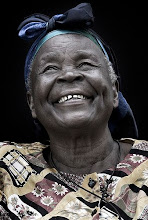
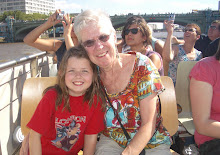
At the Women's march

At the Women's march
All Lives Matter

Never Again

Never Again
We Won't Go Back

Tuesday, December 2, 2008

CELEBRATING THE HOLIDAYS WITHOUT THE COMMERCIALS

Yes, Virginia, there are ways to have a good time with your grandchildren without spending their inheritance before the end of the year. In addition to the suggestions I made in my last post, you can find a host of new, original, inexpensive activities that can bring the kind of closeness we all want with our grandkids.

One terrific resource is the Campaign for a Commercial-Free Childhood. This national coalition of health care professionals, educators, advocacy groups, parents, and individuals who care about children is devoted to limiting the impact of commercial culture on children, and has just produced the free, downloadable "CCFC Guide to Commercial-free Holidays."

Download it by going to:
http://www.commercialfreechildhood.org/pdf/CommercialFreeHolidayGuide.pdf. Here you’ll find such great ideas as:
• taking a grandchild to a grocery store to buy fixings for a complete holiday meal and then taking those fixings to a local food bank
• giving a toddler one of your old purses and filling it with comb, old wallet, fake jewelry, change purse with loose change, band-aids, and other items like the ones she’d find in your purse
• making little coupons that are good for, say, a day’s shopping with you (sure to be popular with teenage girls, and not too pricey if you set limits ahead of time), or a movie and lunch, a hike, a trip to see holiday decorations, or some other shared activity
• making your own play-dough and giving plastic knives and other small inexpensive implements to use with it.
• And more, enough to keep you busy all season long.

Monday, December 1, 2008

GIFTS FOR GRANDKIDS

This holiday season many grandparents are saddened by the fact that they can’t give the same lavish presents to the same number of grandchildren that they have given in years past. In flusher times some might have shelled out for a Wii to play games with their grandchildren or a camcorder to visit with them across the miles (both of which I write about in SUPER GRANNY). But in today’s economy more will be inspired by the gift-giving practice of another granny I interviewed for the book – taking her grandkids to the local Goodwill or Salvation Army store and telling them to pick out “anything you want.”

You can show your love for your grandchildren in loads of ways without running up a huge credit card bill and buying into the high-priced “commercial clutter” advertised on TV. The best gift, of course, is your time. The things you do together are the memories that your grandchildren are most likely to cherish in years to come. You can take them on simple trips to local museums, performances, or skating rinks. You can do crafts activities together and then leave the finished products with the child. You can bake cookies together – just because it seems like a stereotyped “granny” activity doesn’t mean it isn’t fun even for modern grands and kids. Especially if you bake a grandchild's favorite kind and decorate them with pizazz.

And for long-distance grandmothers, there are other ways to show you care. You can send an addition to a collection – a special stamp, a postcard, newly minted state quarters. You can send seeds or bulbs, with the promise of working on them together the next time you visit. You can send funny cards or emails, tell jokes and riddles over the phone, and for the little ones, record yourself reading a book and send the cassette or CD along with a copy of the book. Many of the classic children’s books are available in low-priced paperback versions.

And always remember: We don’t stop playing because we grow old – we grow old because we stop playing.

Tuesday, November 18, 2008

GRANNY CARE IS SAFEST CARE

It's a familiar refrain to many of us grannies who take care of our grandchildren from time to time -- or even most of the time. "Careful! Do it this way! Are you sure you'll be all right? Here's the [3-page, single-spaced] list of what to do. Mom!" And so on and so on.

Have they forgotten that we've raised at least one child to adulthood? Do they think that just because we became grandmothers we've lost every drop of smarts? Do they think we're hopelessly mired in the past and that we can't cope with today's children? That we don't read newspapers and learn new tricks of the child-caring trade? Plenty of times the answer is an emphatic YES.

Grandparenting workshops make the same assumption when they tell us how to put babies to sleep (on the back, not the tummy), how to strap them into car seats (very securely -- duh!), what temperature to make the bath water (not too hot, not too cold -- just right). Even academics have voiced the concern that older relatives like us are too incompetent to take care of kids. As one put it: "Recent growth in the number of grandparents providing childcare has some observers concerned they don't adhere to modern safety practices."

And yet -- and yet – these same academics have now told us that we do a great job! Children are safest when Granny watches them. Yes, safer than daycare, safer than other relatives, even safer than Mommy. Researchers from the Johns Hopkins Bloomberg School of Public Health followed more than 5500 newborns in 15 U.S. cities until the children were 30 to 33 months old. They kept track of who took care of the children and of all the doctor and emergency room visits for causes ranging from "cut face," to "drank paint thinner," to "fall from shopping cart." Scary stuff -- especially since injury is the leading cause of childhood deaths in the U.S. After adding up all the data, grandmothers came out way ahead: children cared for by a granny have half the risk of injury than kids in those other situations.

Check it out. The article is in the November issue of "Pediatrics," the journal of the American Academy of Pediatrics. The lead author of the study is Professor David Bishai, M.D., Ph.D., M.P.H. of Johns Hopkins, and you can access a summary of the study findings at: http://pediatrics.aappublications.org/cgi/content/abstract/122/5/e980.

Thursday, November 13, 2008

FIRST GRANNY

Another grandmother in the next First Family is now in the news. When the Obamas move to Washington in January, they’ll be taking Michelle Obama’s mother with them. Marian Robinson, 71, described as “the most important addition to the new White House team,” has taken care of Malia, ten, and Sasha, seven, while their parents campaigned, and she’ll continue to give grandmotherly care after President-elect Obama takes office. This will be the first time in living memory that three generations of a new presidential family will have moved together to the capital.

Like other caregiving grannies, Mrs. Robinson has been driving the girls to school, gymnastics, ballet and soccer practice; and supervising their homework. She has also prepared many meals, which sometimes have consisted of fried chicken, cooked by her own recipe. One of the casualties of her sudden ascension to the limelight is the secrecy of her recipe. Journalists have pried loose some of her closely held secrets, including using crumbled Ritz crackers in the batter, bathing the chicken pieces in ice water before frying to make it crispier, adding salt literally, and using “lots of oil.” Now, I wonder whether the Presidential chef will be able to make it as well, or will Granny have to go into the White House kitchen herself?

And although Grandma mostly pays attention to their mom’s strictures, she doesn’t always limit the girls to only one hour of TV a day or make sure they go to bed by 8:30. She has said, “I have candy, they stay up late – come to my house, they watch TV as long as they want to, we’ll play games until the wee hours. I do everything that grandmothers do that they’re not supposed to.” There is something about granny privilege.

Sunday, November 9, 2008

OBAMA’S GRANDMA

He called her “Toot” – short for “Tutu,” the Hawaiian word for grandmother. He often acknowledged Madelyn Dunham as the woman who helped to raise him in Hawaii while his single mother worked abroad. “Toot’s” last acknowledgment of him before her death this month at 88 was the absentee ballot she mailed in to add her vote to the millions that elected her grandson to become the 44th President of the United States. She died before the election, but she probably knew in her heart that he would prevail.

When Barack Obama heard how very ill his beloved grandmother was, he interrupted his presidential campaign to go to her side. Another, lesser man might have said, “The campaign has only a few more days to go – I’ll wait and go to see her then. She’ll understand.” But in a sign of smart and compassionate decision making, he knew that the time to go was now, he flew to her side, and he was able to see her one last time.

Like many other grandparents raising grandchildren, Madelyn Dunham exerted an important influence on the young Barack. He has acknowledged her as having had an impact that “was meaningful and enduring.” According to the blog “Hawaii Insider,” a relationship like theirs is described by the Hawaiian word “‘ohana,” which means “family,” and comes from “‘oha,” which means the offshoot of the taro root, the staple food of Hawaii. Family, then, is a place to feed each other and to be fed. As one Hawaiian proverb has it, “Ike aku, ‘ike mai, kokua aku, kokua mai; pela iho la ka nohana ‘ohana,” or “Recognize others, be recognized, help others, be helped; such is a family relationship.” I couldn’t think of a better explanation for the meaning of family.

Thursday, November 6, 2008

WHEN GRANNY STANDS IN FOR MOMMY

When my friend and colleague Ruth Duskin Feldman of Highland Park, Illinois took two small grandsons and one granddaughter to “Moms and Tots” classes starting some nineteen years ago, she was the only grandmother in the class. At the time she didn’t realize what a trend-setter she was. This year, after finding nine out of ten children in one class accompanied by their grandmothers, the owner of one children’s gym on Long Island (New York) renamed its “Mommy and Me” classes “Anyone and Me.” Who are the “anyones”? Mostly grandmothers.

Grandma Ruth took over the care of Daniel, and then his younger brother, Emmett, two days a week so that her daughter, Laurie, could work part-time. From the time each of the boys was six months old, Ruth regularly picked them up and brought them to her home, an arrangement that worked out well for everyone. Mom and Dad went to work with an easy mind, knowing their children were being well cared for; Grandma built a close relationship with the children, while not sacrificing her own writing career; the children had loving, caring family around them all the time; and Grandpa got quality grandkid time too.

Even after Laurie’s daughter, Rita, was born and Laurie was home full-time, Ruth picked up the children at least one day a week and took them to classes. (When Ruth’s other five grandchildren were infants, they all lived too far away for Ruth to share parenting in the same way.)

Ruth expressed the value of shared parenting in an article she wrote for New Choices Magazine: “I’m not Daniel’s mother, but I am a partner in guiding his development. Because I’m his grandmother, what I do with him goes beyond babysitting – beyond keeping him fed, dry and out of danger. I wonder how many babysitters are willing to shop for just the right toy or seek out neighborhood playmates and compare notes with their parents. Daniel and I are not merely passing time together a few times a week: we’re building a relationship that’s important for both of us.”

This super granny says, “Grandparent care is an old idea whose time has come again.” She agrees with the observation by Amy Goyer, national coordinator for the AARP Grandparent Program, that as more grandparents these days assume this role, “they are becoming guiding forces in their grandchildren’s lives.”

Grandparents who care for grandchildren either part- or full-time can find a wealth of resources, including the Foundation for Grandparenting, www.grandparenting.org, and Generations United, www.GU.org. Also, you can find more help by searching the Internet for “grandparents raising grandchildren.”

Saturday, November 1, 2008

Minimum Wage for Grandparents

Whenever I’m visiting another city, or another country, I pick up a local newspaper to see what’s on people’s minds there. Last month when Mark and I were in Greece with our daughter and grandson, I found an English edition of Kathimerini, published in Athens.

The October 4-5 issue ran a little story that gladdened my heart, headlined “Bulgarian government to pay pensioners to babysit grandchildren as of January 1.” The story went on to relate how, starting January 2009, pensioners (retired people) will be paid the minimum wage for looking after their grandchildren when they take over child care when the parents return to work.

The Bulgarian Parliament just passed this amendment to the country’s Employment Encouragement law “to help young parents better combine their professional and family engagements.” The amendment allows grandparents to look after a child during its first three years in return for a 240-leva (123 euros, or 156 dollars at current exchange rates) bonus to their pensions, which equals Bulgaria’s minimum wage.

In 2006, in an effort to raise the country’s falling birth rate, Bulgaria introduced measures allowing parents to take 315 days’ leave, the longest in Europe, while continuing to earn 90 percent of their salaries. Wouldn’t both these laws be a godsend here for parents and grandparents!